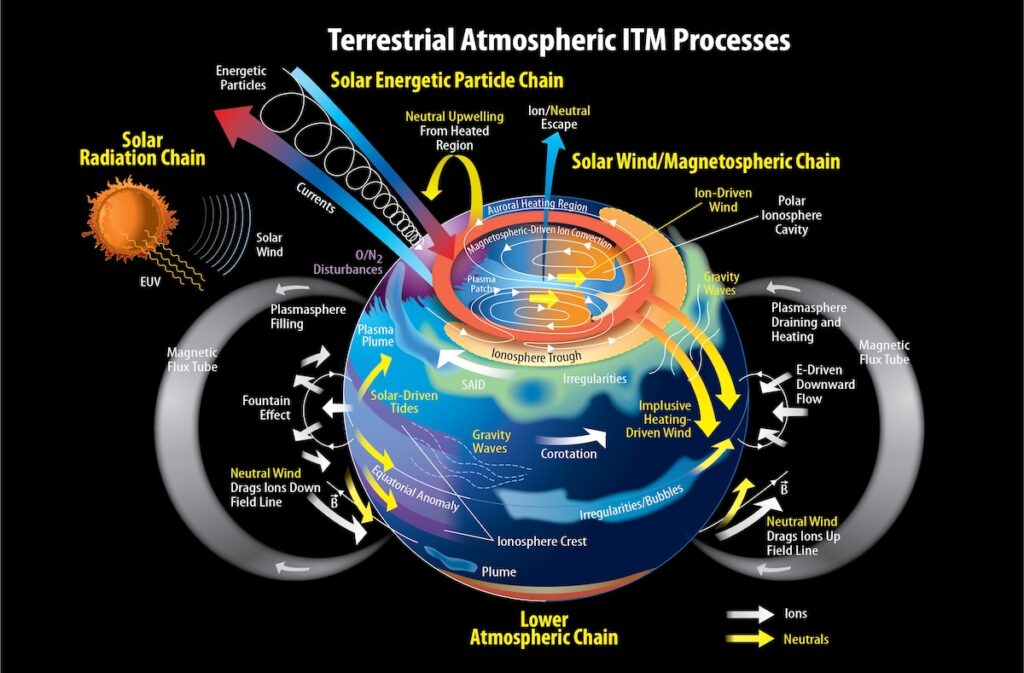
A new study by researchers at Kyoto University proposes an intriguing physical mechanism: disturbances in the ionosphere triggered by intense solar activity (such as solar flares) could, under specific conditions, provide a small additional push to a fault that is already critically stressed, potentially helping to initiate a large earthquake. The authors emphasize that this is not an earthquake prediction method, nor a claim that “the Sun causes earthquakes,” but rather a theoretical model exploring a plausible pathway linking space weather and seismic processes.
The core idea: a capacitive, electrostatic coupling from “sky to crust”
The ionosphere is an electrically charged layer of Earth’s upper atmosphere that responds strongly to solar activity. During powerful solar events, the ionosphere can experience changes in electron density (often discussed via TEC, Total Electron Content). The model suggests that these changes can create a charged layer in the ionosphere.
The study’s key proposal is how this “upper-atmosphere charge” could connect to what happens underground. The researchers argue that certain fractured zones in the Earth’s crust—especially around faults—could behave like an electrical capacitor (a system that stores charge), establishing an electric field between the crust and the ionosphere. In their scenario, the fractured zone may include high-pressure, high-temperature fluids (potentially even supercritical), rich in ions and therefore able to support electrostatic effects.
How could this affect a fault?
If the crust–ionosphere system behaves like a capacitor, then changes in ionospheric charge during strong solar activity could intensify electric fields inside microscopic voids and cracks within the fractured rock. The model estimates that these fields could generate electrostatic pressure within those tiny spaces. When a fault is already close to failure due to tectonic stress, that extra pressure could contribute to microcrack growth, void collapse, and local weakening, nudging the system toward rupture.
The paper explores this quantitatively and discusses how large, flare-driven TEC variations could, in theory, translate into pressure changes in the crust on the order of megapascals in localized microstructures—an amount that could matter only when the fault is already near its breaking point.
Why this is being discussed now: ionospheric anomalies reported before some major quakes
For years, researchers have reported ionospheric anomalies preceding certain large earthquakes, including changes in electron density and other disturbances. Many explanations focus on “bottom-up” mechanisms—processes in the crust affecting the atmosphere above. What this Kyoto University work adds is a bidirectional framing: the ionosphere might not only respond to crustal stress, but could also produce feedback downward via electrostatic coupling, under the right conditions.
A real-world reference point: the 2024 Noto Peninsula earthquake
The authors mention Japan’s Noto Peninsula earthquake (2024) as an example where strong solar flare activity occurred shortly beforehand. They are careful to note that this does not prove causation—solar flares and earthquakes are both common enough that coincidences can occur—but it is consistent with their “final nudge” hypothesis for faults already at critical stress.
What this means (and what it doesn’t)
What the study does not claim
- It does not claim solar flares directly “cause” earthquakes.
- It does not provide a reliable way to forecast earthquakes.
- It does not imply every strong solar event will be followed by a quake.
What it contributes
- A clearly articulated, physics-based model connecting space-weather-driven ionospheric charge changes to electrostatic forces in fractured crust.
- A proposed direction for future tests, combining high-resolution GNSS-based ionospheric tomography with detailed space-weather observations to identify when such coupling could be significant.
External article (to link at the end)
ScienceDaily (Kyoto University summary):
https://www.sciencedaily.com/releases/2026/02/260224023209.htm
Official study (recommended to link as the primary source)
International Journal of Plasma Environmental Science and Technology (full paper PDF):
https://ijpest.com/Contents/20/1/PDF/2026-20-e01003.pdf
Paper landing/abstract page:
Leave a Reply